Human Stock
Catalog Essay
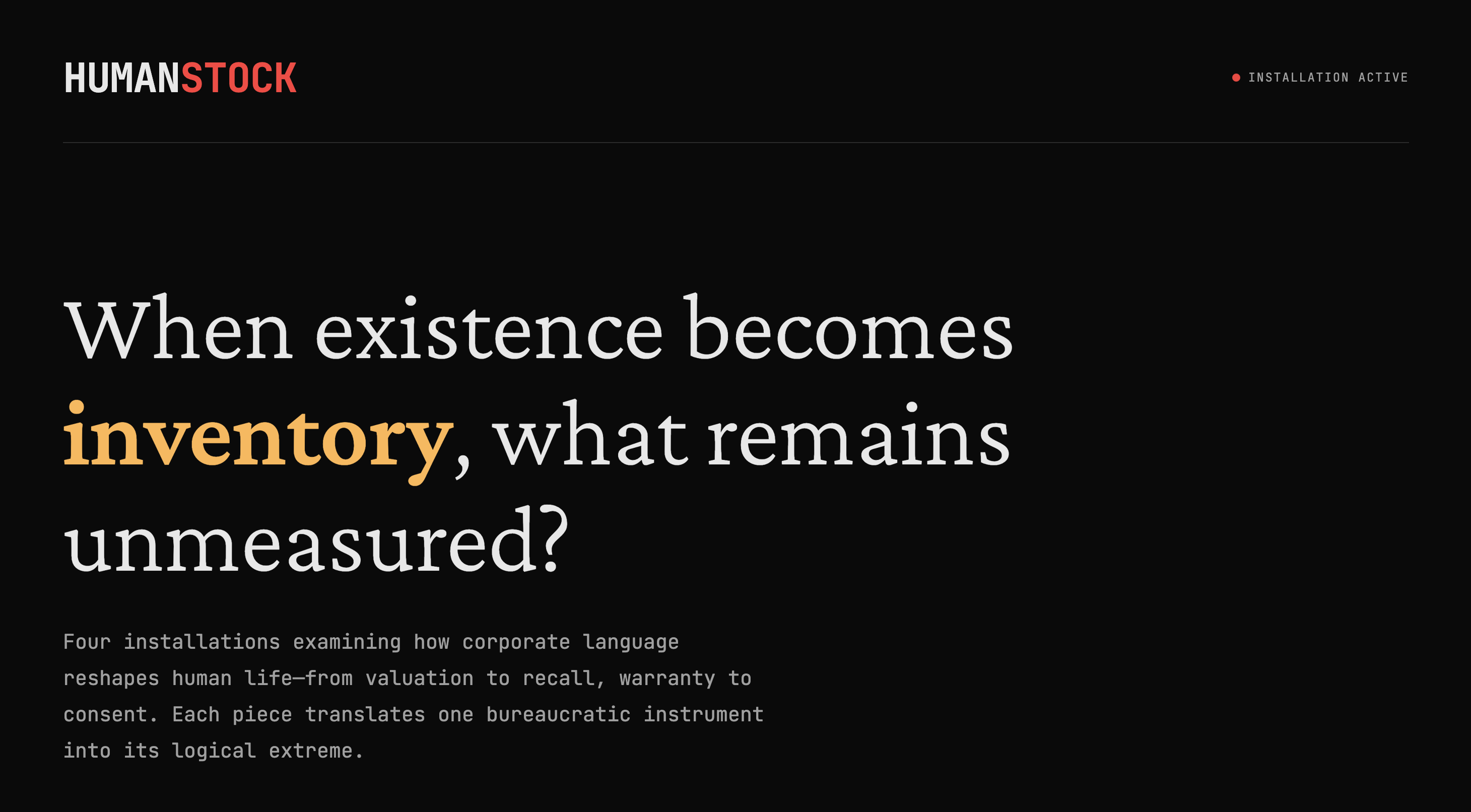
A conceptual installation exploring how human experience is treated as inventory—tracked, optimized, branded, and discarded. When personhood becomes a product, what remains of human value?
Systems That Price the Self
We live in a time when being human is not only experienced — it is evaluated. Identity is tracked, quantified, branded, archived, optimized, and occasionally discarded. What once belonged solely to an interior world of memory, imagination, and contradiction now participates in economies of attention, influence, and productivity. The self has become a negotiable entity.
HumanStock examines this shift: the transformation of the human being into a product managed through the language of systems. The project frames emotional realities as malfunction, change as risk, and growth as obsolescence — presenting the familiar mechanisms of bureaucracy and platform logic as the architecture through which identity is processed.
Each installation adopts the structure of a transactional experience: warranty, consent, valuation, and recall. Together, they trace how systems convert human life into an object that must be serviced, stabilized, and priced — an inventory of emotions reorganized for commerce.
Limited Lifetime Warranty
Care, in Limited Lifetime Warranty, speaks in the language of liability. Support is conditional; compassion is itemized. The promise of protection is undone by exclusions and fine print. Grief, uncertainty, and fatigue are declared "non‑covered events."
The interface imitates sincerity — calm typography, neutral tones, the comforting cadence of legal documentation. But beneath the civility lies machinery: to maintain stability, systems must partition unpredictability from the admissible. Empathy becomes clause. Suffering becomes error. Maintenance replaces meaning.
Limited Lifetime Warranty transforms the language of care into evidence of containment. Medical, corporate, and bureaucratic forms all share a common grammar — one that reclassifies vulnerability into defect. The piece asks what happens when the systems built to protect us become the systems that decide what counts as human.
Terms & Conditions
Negotiating Consent, The Market as Mirror, Redemption and Return
If modernity once promised autonomy, platforms now operationalize consent as a perpetual precondition. Terms & Conditions of the Self expands this paradox: the impossible choice between participation and disappearance. Identity no longer emerges through encounter; it is administratively accepted.
Consent, once imagined as the foundation of liberty, has become the architecture of governance. From Enlightenment contract theory to the modern privacy policy, legitimacy depends not on equality but on acknowledgment — a checkbox that sanctifies asymmetry. Systems no longer need to coerce; they only need to ask. The question appears, the agreement is presumed, and the ritual completes itself. What was once negotiation between humans becomes transaction between user and interface.
Within HumanStock, consent functions not as ethics but as choreography. The everyday ritual of "I Agree" — automatic, rhythmic, polite — converts submission into participation, attention into authorization. The illusion of choice persists precisely because it's frictionless. Decline is symbolic; refusal amounts to erasure. The power of normalization lies not in compulsion but in habit. Every command arrives disguised as invitation.
To click "accept" is not to agree; it is to remain legible. To refuse is not to dissent; it is to vanish.
The self, once organized around expression, is now organized around permission. Each consent deepens the archive; each archive strengthens the institution. Autonomy becomes formatting — the ability to exist only within predefined fields.
Negotiating Consent
This movement examines acceptance as rhythm — the choreography of compliance that structures digital life. The user interface becomes confessional: sterile, polite, infinitely accommodating. Language so neutral it erases itself becomes the instrument of control.
The work reveals how repetition replaces decision until consent ceases to be an act and becomes an atmosphere. The bureaucratic tone — calm, precise, inoffensive — carries a subtle violence. The system smiles as it extracts.
Resistance is not punished; it is made irrelevant. The machinery of consent relies on comfort, not coercion — on design that flatters the user into obedience. In this system, there are no tyrants, only terms.
The Market as Mirror
From this condition of consent emerges valuation. What begins as acknowledgment becomes appraisal. The same systems that register permission now quantify relevance.
The Market as Mirror reflects how contemporary culture translates selfhood into measurable performance. Worth no longer relates to truth, but to metrics: visibility, influence, interaction, and velocity. The social becomes the speculative; relevance replaces reality as the measure of existence.
This dynamic is not new — only newly intimate. The industrial age measured bodies in efficiency, the information age measures minds in engagement. Now, the person becomes the product: worth oscillates with attention, identity transacts like equity.
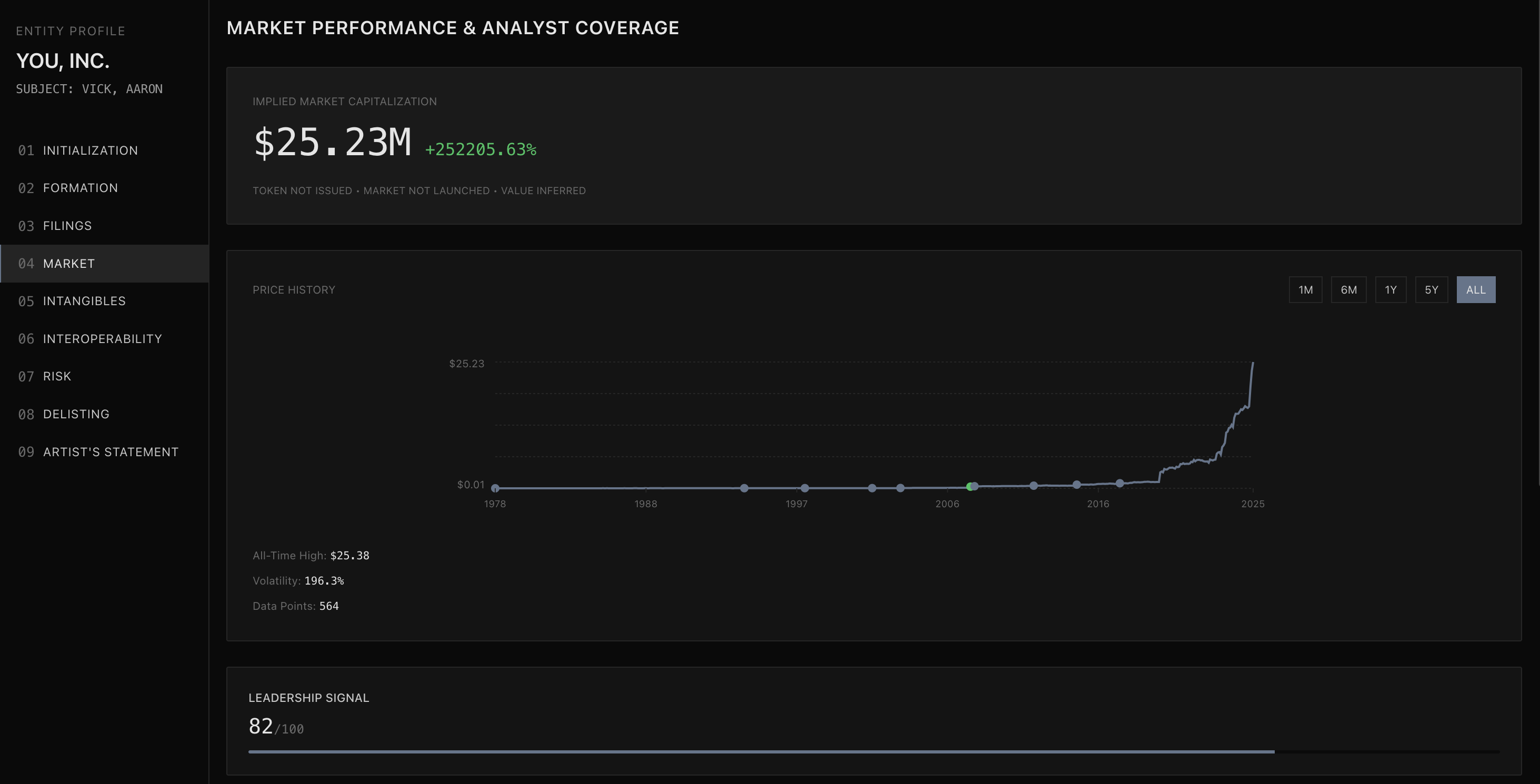
Visually, this sequence mirrors You, Inc. — the Bloomberg‑style interface that renders the human as ticker. White sans serif text on black; activity rendered as market movement. The aesthetic is not parody but precision: a faithful portrait of a civilization fluent in quantification.
The viewer, confronted with this apparatus, recognizes its grammar in their own habits — the daily reflex of optimizing for visibility, the internalized volatility of relevance. The market's logic has become interiorized: to exist is to perform stability for an invisible audience.
Here, HumanStock collapses critique and mirror. What it shows is not an abstraction but an exact reflection of the systems through which we already live.
Redemption and Return
The final movement presents the fantasy of reversal. In Redemption and Return, the system offers what looks like escape — a promise to "unsell" the self. The format borrows from customer service: refund policies, coverage limits, corporate apologies. It promises to restore what was lost: autonomy, wholeness, privacy.
But the act of reversal reproduces the same mechanisms it hopes to reject. Each attempt to withdraw generates new documentation: confirmations, receipts, trace logs. Even refusal becomes data.
The language of liberation and the language of compliance collapse into one another. Exit routes fold back into the system's ledger. The attempt to recover the self becomes proof of its continued participation.
What remains possible is not departure but awareness: an aesthetic awakening to structure. Recognition, not resistance — because resistance strengthens the geometry it opposes. Recognition reveals that the system's authority is architectural, not divine. It was built; therefore it can be seen, studied, potentially unlearned.
This final gesture becomes Terms & Conditions' quiet thesis: awareness is the last unsellable act.
You, Inc.
The Human Ticker — A Genealogy of Value
You, Inc. situates valuation in the historical continuum of commodified personhood. The conversion of humans into tradable assets did not begin with blockchain. It is older than any technology convenient enough to blame.
Whenever a system seeks to allocate resources, predict behavior, or extract value, it renders people into legible units: comparable, quantifiable, manageable. From Roman censuses to colonial registries, from actuarial tables to credit scores, legibility has been synonymous with control.
Industrial capitalism scaled this operation. Scientific management turned labor into time‑motion data; actuarial science converted mortality into probability; reputation markets transformed credibility into a tradable future. By the time algorithms arrived, the methodology was already ancient — the machine simply perfected its efficiency.
BitClout and the creator‑token platforms of the 2020s made this dynamic explicit: the marketplace stopped pretending the person and the product were different. Identity became the asset; speculation replaced participation. The promise of empowerment masked the deeper continuity — freedom offered as the ability to optimize one's own commodification.
You, Inc. replays this genealogy through data aesthetics. On the Bloomberg‑like interface, a live valuation index calculates the artist's "price" via search metrics, sentiment data, and algorithmic prediction. Every professional or personal event registers as market fluctuation. Life becomes performance reporting; biography merges with investor relations.
The work does not parody finance — it reveals its colonization of experience. The "Request to Delist" button mocks the desire for exit: each plea for removal generates another record. The denial is bureaucratic, procedural, polite — "entity remains sufficiently mentioned in public discourse to maintain listing requirements."
You cannot opt out of a market that never asked permission to list you.
Recall Notice
Recall Notice serves as both coda and confession. It echoes the final language of bureaucracy — closure written as apology, accountability reduced to formatting. Where Warranty begins with care and Terms & Conditions institutionalize consent, Recall Notice performs reckoning.
Here, the system admits malfunction, but only to protect itself. The tone is legalistic, sanitized — empathy expressed as liability avoidance. Notification stands in for accountability. Every failure is recalled not to repair, but to manage exposure.
The work translates this logic into human terms: a life reviewed as defective product. A gesture misinterpreted becomes risk. A relationship forgotten becomes noncompliance. Regret and error are renamed as inefficiencies.
Yet Recall Notice also carries tenderness. By borrowing the format of corporate recall, the project transforms bureaucratic distance into accidental poetry. Phrases like "This defect may affect your ability to continue" or "Please discontinue use of your former self immediately" echo with grim humour and impossible sincerity.
Through its coldness, warmth leaks in: the recognition that failure is the most human event of all. In that fissure — where accounting meets emotion — HumanStock reveals its final truth: systems cannot fully contain what they are built to measure.
Epilogue
Across all four sites, HumanStock uses the vocabularies of warranty, consent, valuation, and recall to expose the gap between how systems describe human experience and how humans live it. The project does not propose an alternative system; it reveals that we already inhabit one so total it feels natural.
This is not documentation of a future where people might become products — it is portraiture of a present in which personhood already operates as inventory.
If these mechanics feel absurd, it is because they are familiar. If they feel inevitable, it is because the language that governs identity rarely asks permission — it only asks for compliance.
HumanStock closes with recognition, not reconciliation. Systems are designed to evaluate; people are designed to evolve — unpredictably, inconveniently, and beautifully beyond measure.
Human beings are not products, even when they are priced like them.
—Aaron Vick
Installation Pieces
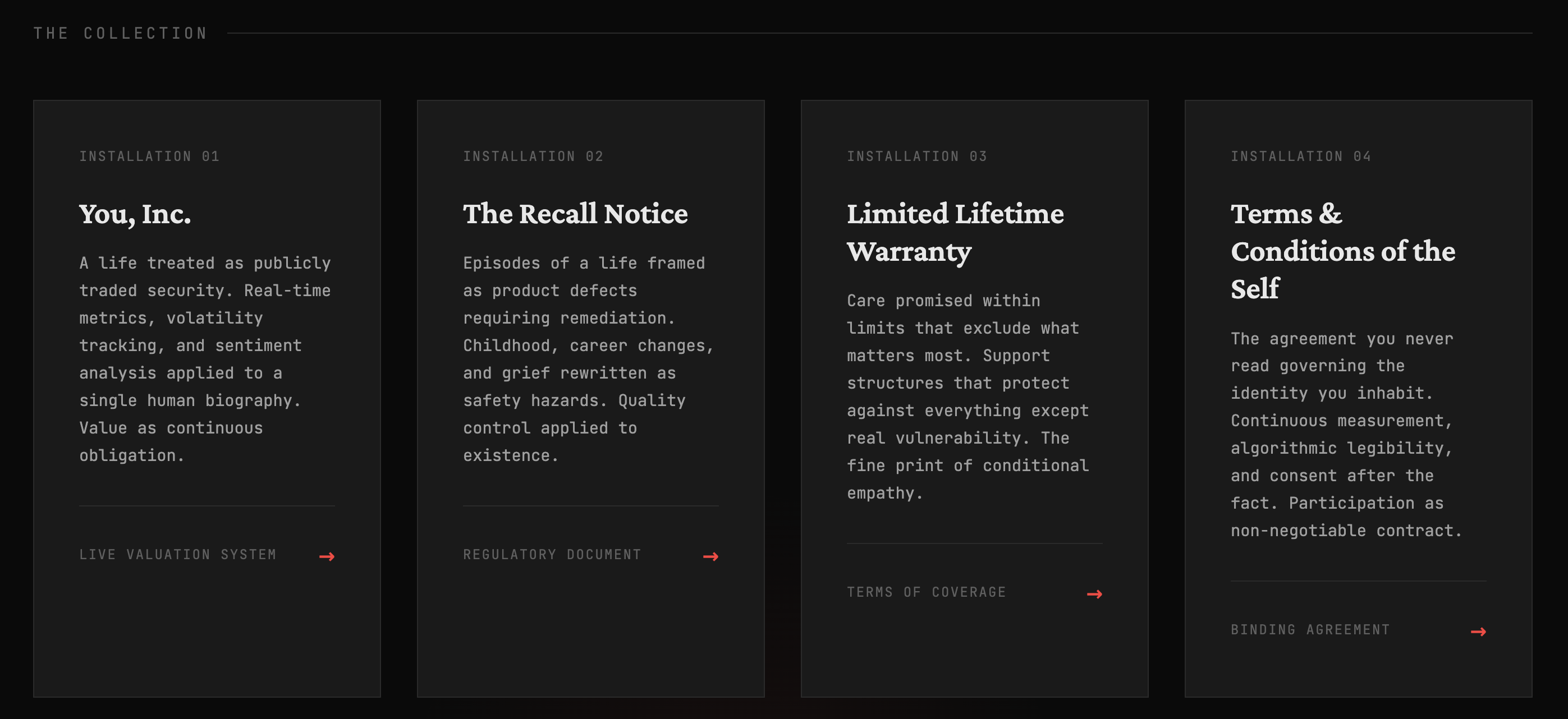
YOU, INC.
A human ticker that prices personhood through algorithmic violence. A provocative exploration of how economic systems quantify human value.
The Recall Notice
Economic systems discontinuing humans through bureaucratic processes. A documentation of how systems quietly exclude and invalidate human existence.
Warranty
A limited lifetime warranty for human life. When support sounds like a promise but is mostly fine print about what isn't covered.
Terms & Conditions of the Self
A conceptual web-based artwork examining how systems evaluate, categorize, and manage human identity through the language of bureaucracy, warranties, and terms of service.